

How to Choose a Digital Marketing Agency: A Complete Guide
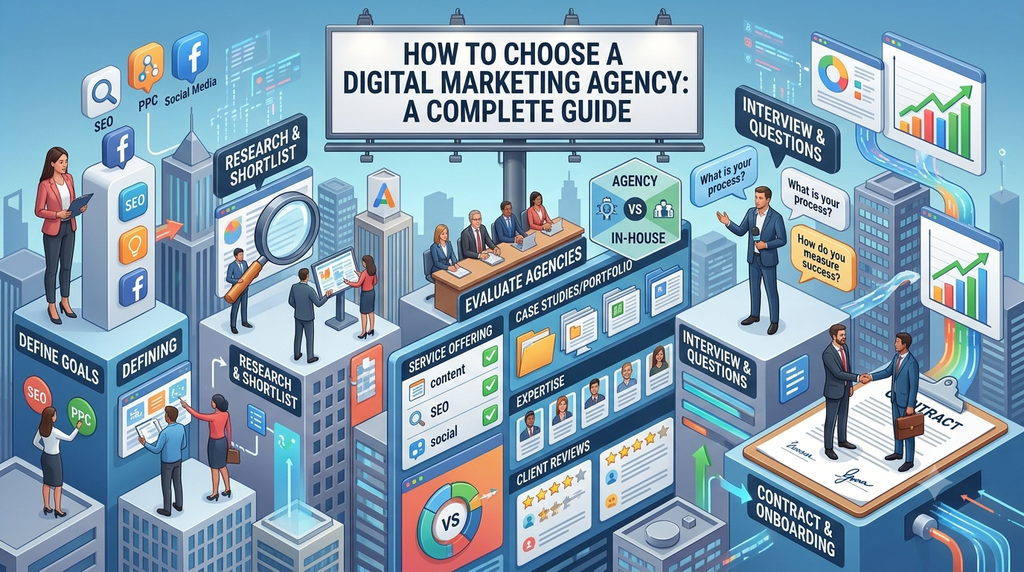
This image illustrates the essential steps involved in choosing the right digital marketing agency for a business. It highlights important factors such as defining business goals, researching and shortlisting agencies, evaluating services and portfolios, checking expertise, reviewing client testimonials, and conducting interviews. The visual also compares agency services with in-house marketing teams and emphasizes the importance of asking the right questions before making a decision. With its professional infographic design, business-focused illustrations, and blue color scheme, this image provides a clear overview of how businesses can select a reliable digital marketing partner to improve their online presence, reach their target audience, and achieve sustainable growth. It is ideal for digital marketing blogs, agency selection guides, business websites, and educational content.
Choosing the right digital marketing agency is a tough decision for any business. Almost every company today wants a strong online presence, more customers, higher sales, and a growing brand. But with so many providers offering similar services, it’s hard to know which one is actually right for you.
Some focus on SEO. Others specialize in Google Ads, social media, content, web development, or complete packages. Many also promise quick results, more traffic, and higher sales. But good marketing isn’t about picking the loudest promise on .
The right partner should understand your business, your target audience, your competition, and your long-term goals. It should also be open about its strategy, pricing, reporting, and expected outcomes.
Google’s own guidance says useful online content should be created primarily for people and offer clear, valuable information. The same idea applies when you pick a marketing partner: look for real expertise, honesty, and a strategy that makes sense for your business.
In this guide, we’ll explain how to choose a marketing agency, what factors to consider, which questions to ask before hiring, which mistakes to avoid, and how to find a team that can become a long-term growth partner.
What Is a Digital Marketing Agency?
A digital marketing agency is a company that helps businesses promote their products, services, and brands through online channels.
Depending on the company, its services may include:
- Search Engine Optimization (SEO)
- Social media marketing
- Google Ads and Pay-Per-Click (PPC) advertising
- Content marketing
- Email marketing
- Website design and development
- Local SEO
- Online reputation management
- Conversion rate optimization
- Analytics and performance tracking
The services you need depend on your goals. A local restaurant, for example, may need local SEO and social media marketing. An e-commerce store may benefit more from SEO, Google Shopping campaigns, and conversion optimization.
That’s why your choice should start with your business objectives, not with the cheapest package on the list.
Why Choosing the Right Digital Marketing Agency Matters
Digital marketing is an investment of both money and time. If you pick the wrong partner, you may pay every month for services without seeing meaningful results.
A good one, on the other hand, can help you build a structured strategy, reach the right audience, improve your online visibility, generate qualified leads, and support long-term growth.
The difference often comes down to whether the team focuses on real business outcomes instead of vanity metrics. For example, 1,000 website visitors may sound impressive. But if none of them become customers, the traffic alone doesn’t help much.
So ask yourself what you actually want:
- More qualified leads?
- More online sales?
- Better Google rankings?
- More local customers?
- Greater brand awareness?
- Better social media engagement?
- A stronger website?
- A complete online marketing strategy?
Your answer will help you find a provider whose expertise matches your needs.
14 Things to Check Before You Hire
1. Start by Defining Your Marketing Goals
Before you contact anyone, decide what you want to achieve. A common mistake is saying, “I want digital marketing,” without knowing what success looks like.
Instead, set a specific objective.
Weak goal: “I want more online visibility.”
Better goal: “I want to generate more qualified leads from my website.”
Weak goal: “I want better social media.”
Better goal: “I want to build brand awareness and generate enquiries through social media.”
Clear goals make it easier to build a suitable plan and measure progress.
2. Check Their Experience
Experience is one of the most important factors. Look at how long the company has been working in the industry and, more importantly, whether it has handled businesses like yours.
Industry experience helps because every business has different customers, sales cycles, competitors, and challenges. Marketing for an e-commerce store, for instance, is very different from marketing for a local service business or a B2B company.
Ask questions like:
- Have you worked with businesses like mine?
- What kind of clients do you usually serve?
- Which channels have worked for similar brands?
- Can you show relevant case studies?
They don’t have to specialize only in your industry. But they should show that they understand your type of business and audience.
3. Look at Case Studies and Real Results
A professional team should be able to explain what it has done for past clients. Look for case studies that cover:
- The client’s original problem
- The strategy used
- The services involved
- How long the campaign ran
- What changed afterward
- Which metrics were used to measure success
Be careful with vague claims like “We increased traffic dramatically” or “We helped a business grow.” Ask for more context. Did that traffic bring in leads? conversions improve? sales or enquiries go up?
A good case study helps you understand the approach. It shouldn’t just dazzle you with big numbers.
4. Understand What Services You Actually Need
You don’t necessarily need every service. A good partner will learn about your business before recommending anything.
- Want organic traffic? SEO and content marketing may be important.
- Want paid visibility right away? Google Ads or other paid advertising can help.
- Want to build a community? Social media marketing and content creation may fit better.
- Want online sales? SEO, paid ads, conversion optimization, and a strong online store may work together.
The right plan depends on your goals, audience, budget, industry, and competition. Be cautious if someone tries to sell you a big package without asking meaningful questions first.
5. Check the People Behind the Brand
The people working on your account matter as much as the company name. During the sales process, you may speak with a senior strategist or a business development manager. But the day-to-day work may be handled by someone else entirely.
Ask:
- Who will manage my account?
- Who will handle SEO?
- Who will run the ad campaigns?
- Who will create the content?
- How experienced is the team?
- How often will we talk?
Knowing who actually does the work prevents misunderstandings later. A strong team will happily explain its structure and responsibilities.
6. Ask About Their Strategy
Don’t hire someone just because they offer many services. Ask how they plan to reach your goals, and expect an explanation in simple language.
An SEO plan, for example, may look like this:
Website Audit → Keyword Research → Technical Improvements → Content Strategy → On-Page SEO → Link Building → Performance Tracking → Continuous Optimization
A paid advertising plan may look like this:
Audience Research → Keyword Research → Campaign Setup → Ad Creation → Landing Page Optimization → Conversion Tracking → Testing → Optimization
The exact process will vary, but there should always be a clear reason behind each recommendation.
7. Check How They Measure Success
One of the most important questions is: “How will you measure the success of my campaign?”
Different businesses track different KPIs, including:
- Website traffic
- Organic search visibility
- Keyword performance
- Leads and qualified leads
- Conversion rate
- Cost per lead
- Customer acquisition cost
- Online sales
- Return on ad spend
- Revenue
Don’t focus only on likes, impressions, or followers. Those numbers can be useful, but they don’t always show whether your marketing is helping the business. A good partner links performance to meaningful business goals.
8. Look for Transparent Reporting
Reports should be clear enough for you to understand what’s being done and what it’s producing. Ask to see an anonymized sample before you sign anything.
A useful report explains:
- What work was completed
- What changed
- What performed well
- What didn’t
- What the key metrics mean
- What happens next
You shouldn’t need to be a marketing expert to tell whether a campaign is moving in the right direction. Transparency matters even more when you’re spending a lot of money.
9. Understand the Pricing Before You Sign
Price matters, but the cheapest option isn’t always the best. Providers use different pricing models, including:
- Monthly retainers
- Project-based pricing
- Hourly consulting
- Performance-based models
- Custom packages
Ask exactly what’s included. For example:
- How many pages of content?
- How many social media posts?
- Is ad management included?
- Is the ad budget separate?
- Are website changes included?
- Are design services included?
- Are reporting and analytics included?
A low price can look attractive at first, but unclear deliverables cause problems later. Aim for the best value, not just the lowest cost.
10. Ask About Communication and Support
Good communication makes a big difference in any client relationship. Before signing, find out:
- How often will you get updates?
- Who is your main contact?
- How quickly do they usually reply?
- Will you have regular meetings?
- How are approvals handled?
- How are urgent issues raised?
A firm can have excellent technical skills, but if communication is poor, the relationship becomes frustrating. Choose one that treats communication as part of the service.
11. Make Sure You Own Your Business Assets
This point is easy to overlook. You should keep ownership of, and access to, important digital assets such as:
- Your website
- Your domain
- Google Analytics
- Google Search Console
- Advertising accounts
- Social media accounts
- Business profiles
- Creative files
- Customer data
Your partner should get the access it needs to do the work, but you shouldn’t become completely dependent on it. Before signing a contract, confirm ownership and account access in writing.
12. Ask About the Expected Timeline
Be realistic about results. SEO, content, social growth, and paid ads don’t all work on the same schedule. SEO usually needs consistent effort and time to build visibility, while paid ads can deliver visibility much faster when campaigns are set up well.
A professional team should explain:
- What can realistically happen in the first 30 days
- What the first 60–90 days may look like
- Which results are short-term
- Which results are long-term
- What factors could affect performance
Avoid anyone who guarantees specific Google rankings or unrealistic results without understanding your market.
13. Watch Out for Red Flags
Knowing what to avoid is as important as knowing what to look for. Here are the common warning signs.
Guaranteed Google Rankings
No legitimate provider can fully control Google’s ranking systems. Be cautious if someone promises a specific position.
Unrealistic Promises
Claims like “10x sales in 30 days” deserve suspicion unless there’s strong evidence and a clear explanation of how it could happen.
Extremely Low Pricing
Low pricing isn’t automatically bad. But a very cheap offer can mean limited resources, generic work, or little attention to your account.
No Clear Reporting
If they can’t explain how they measure results, think carefully before hiring them.
Long Contracts With Unclear Terms
Understand the contract, cancellation terms, deliverables, payment structure, and responsibilities before you sign.
One-Size-Fits-All Strategy
Your business is different from every other one. Your plan should reflect your audience, goals, competition, and budget.
14. Ask These Questions Before Hiring
Before you decide, ask:
- What experience do you have with businesses like mine?
- Can you show me relevant case studies?
- Who will actually work on my account?
- What strategy would you recommend for my business?
- Which KPIs will you track?
- How often will I receive reports?
- What exactly is included in your pricing?
- Are advertising costs included or separate?
- Who owns my website, accounts, and data?
- What should I realistically expect in the first 90 days?
- How do you handle underperforming campaigns?
- What happens if I decide to end the contract?
The quality of the answers tells you a lot about how professionally they operate.
How to Compare Different Digital Marketing Agencies
Don’t choose the first company you talk to. Make a shortlist of about three and compare them using the same criteria. A simple scorecard can help:
| Factor | Importance |
|---|---|
| Relevant experience | High |
| Case studies | High |
| Strategy | High |
| Reporting | High |
| Communication | High |
| Team expertise | High |
| Pricing transparency | High |
| Contract flexibility | Medium |
| Services offered | Medium |
| Cultural fit | Medium |
This keeps the decision objective and stops you from choosing someone just because their sales pitch was impressive.
Should You Choose a Freelancer or a Marketing Agency?
It depends on your needs. A freelancer may suit a small project or a single specific skill. A larger team may be better when you need several services working together.
But the type of provider matters less than the person or team behind it. What counts is whether they have the skill, experience, communication, and accountability needed to reach your goal.
Final Checklist Before Hiring
Before signing anything, make sure you understand:
- Your marketing goals
- The services you’re buying
- The expected deliverables
- The total cost
- The advertising budget
- The reporting process
- The communication process
- The team responsible for your account
- Account and data ownership
- Contract length
- Cancellation terms
- The expected timeline
- Key performance indicators
If all of this is clear, you’re in a much stronger position to make an informed decision.
Conclusion
Choosing a digital marketing agency isn’t just about finding the lowest price or the flashiest website. It’s about finding a team that understands your business, knows your audience, has relevant experience, communicates clearly, and uses sensible strategies to support your goals.
Before you hire, take the time to define your objectives, compare several options, review their case studies, ask detailed questions, understand the pricing, and check how success will be measured. Most importantly, look for transparency.
A good partner won’t just tell you what you want to hear. It will explain what’s realistic, what needs improvement, which strategy it recommends, and how progress will be tracked.
Marketing works best when both sides work together like partners. With the right strategy, communication, and expectations, the right team can become an important part of your long-term online growth.
Ready to Choose the Right Digital Marketing Partner?
Finding the right partner can make your online growth far more structured and effective.
If you’re looking for professional digital marketing services, our team can build a strategy around your business goals, target audience, and budget.
From SEO and social media marketing to Google Ads, content marketing, and website optimization, we can help you build a stronger online presence and reach the right customers.
Get in touch with our team today, and let’s create a digital marketing strategy designed around your business goals.